Roofing guide · Jacksonville, FL
Signs your Jacksonville roof is near the end of its life
By Holden Lovett, Roofing Guides Editor · Updated September 2026
Roofs rarely fail all at once. They send signals for years: granules in the gutters, curling edges, a stain that keeps coming back. Here is what to look for, where to look, and how to tell a roof that needs a repair from one that needs replacing.
- Roof condition
- Repair or replace
- Jacksonville, FL
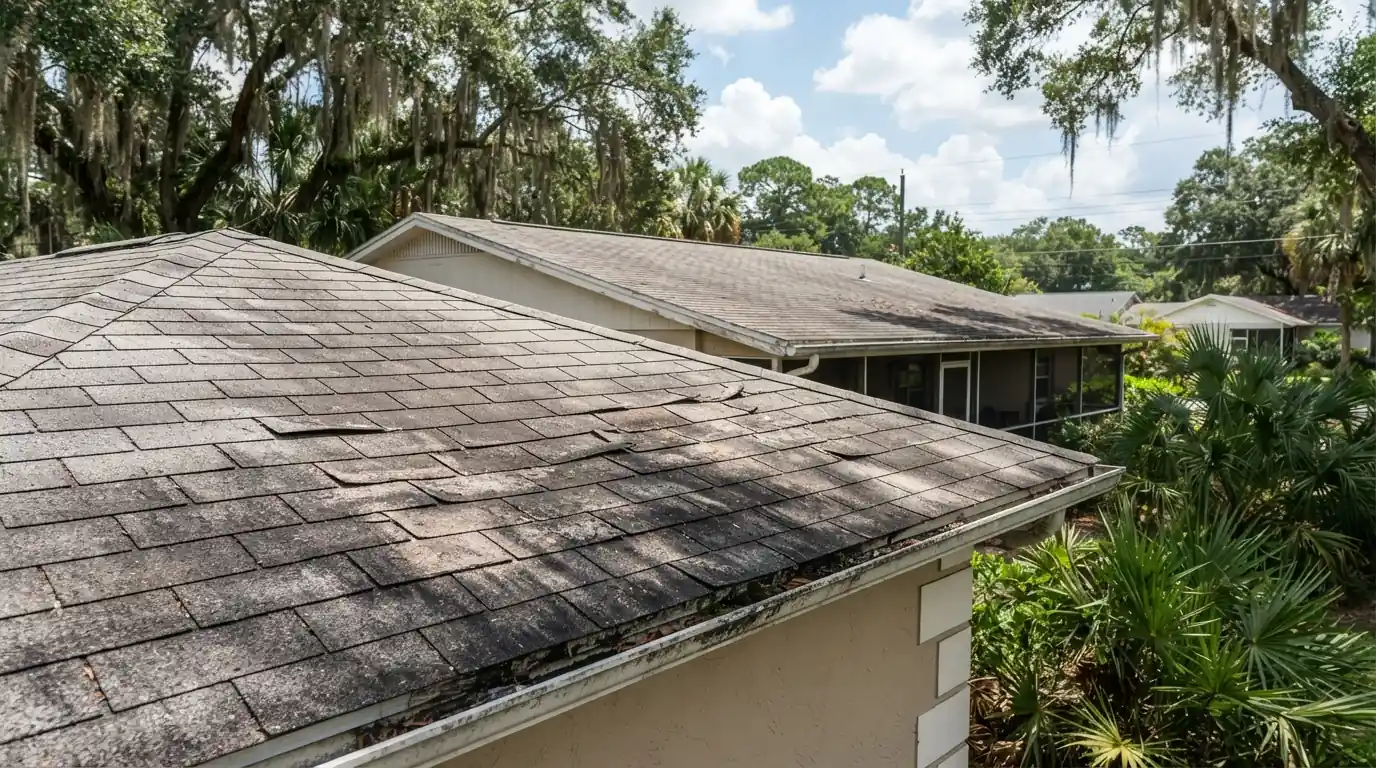
The signs a Florida roof is near the end are granules collecting in gutters, shingles curling, cracking or going bald, repeated leaks in different places, a sagging roofline or soft deck, and daylight or widespread stains in the attic. One or two isolated problems usually mean repair; wear spread across every slope usually means it is time to plan a replacement.
Sun, heat and storms
Why Florida roofs age the way they do
Sun and heat do most of the aging here. The Weather Service normal for Jacksonville is 60 summer days at or above 90 degrees, and ultraviolet light and heat break down asphalt, dry out sealants and loosen granules year after year. Storms add sudden damage on top of that slow wear, and humidity works on decks and fasteners from underneath.
That is why age alone is a poor guide. Two roofs installed the same year can be in very different shape depending on color, ventilation, shade and how well they were installed.
From the yard
What to look for from the ground
Binoculars and a walk around the house on a sunny afternoon show most of the signs without anyone climbing a ladder.
- Granules piling up in gutters or at the bottom of downspouts
- Shingle edges curling up, or corners cupping
- Bald patches where the dark asphalt shows through
- Cracked, missing or mismatched shingles from past repairs
- Dark streaks and moss on shaded slopes
- A roofline that dips or sags between rafters
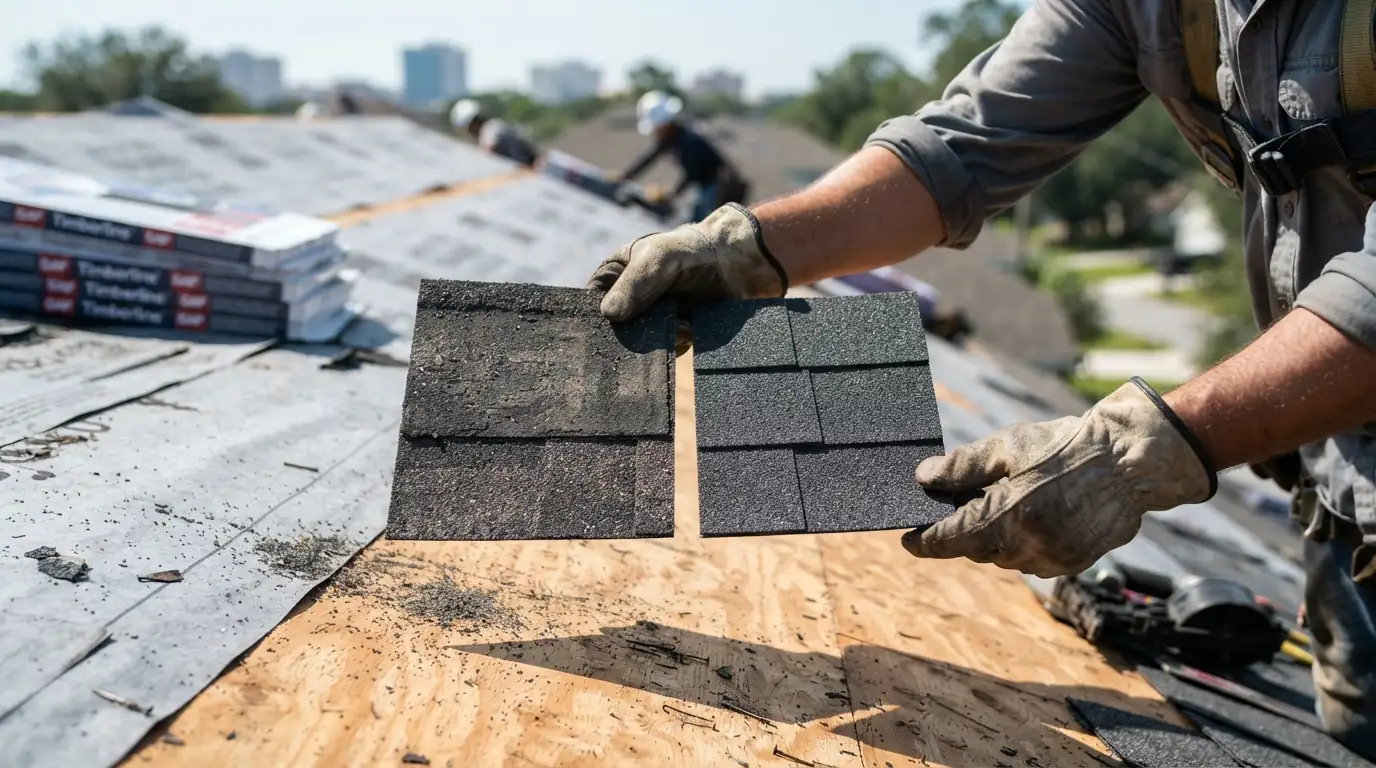
Seeing some of these signs?
Call and we will inspect the roof and tell you plainly whether it needs a repair or a replacement.
From inside
What the attic tells you
The attic shows what the roof hides. Look for daylight through the deck boards, dark or stained sheathing, soft spots, rusted nail tips and insulation that is damp or matted. A few old stains from a fixed leak are not a problem; fresh stains in several places, or a deck that flexes, mean water is getting in at more than one point.
Poor ventilation ages a roof from underneath, too. A very hot, stuffy attic bakes the shingles above it; see roof ventilation.
Other roof types
Metal, tile and flat roofs show it differently
Not every roof ages like shingle. On metal roofs, look for rust at cut panel edges and around fasteners, screws that have backed out, and paint that has faded to a chalky film. On tile roofs, cracked or slipped tiles are the visible part; the real clock is the underlayment beneath them, which usually wears out before the tile does.
Flat roofs age at the seams and wherever water sits. Ponding that lasts days after rain, blisters, split seams and a cracked, alligatored surface all mean the membrane is near the end. See metal, tile and flat roof repair for how each is handled.
The pattern
Repair or replace: how to decide
The line between repair and replacement is not a single sign but a pattern. A roof with one problem is a repair; a roof where problems keep appearing in new places is telling you something.
| What you see | What it usually means |
|---|---|
| One leak with a clear cause | Repair the cause |
| Storm damage on one slope of a newer roof | Repair the damaged area |
| Leaks in several places over a year or two | The roof is wearing out; plan a replacement |
| Granule loss and curling on every slope | Replacement is due |
| A soft or sagging deck | Replacement, with deck repair |
Planning
Insurance and timing
Age matters to insurers even when the roof looks fine. Florida Statute 627.7011 bars insurers from refusing a policy solely because a roof is under 15 years old, and for older roofs lets the owner show five or more years of useful life through an authorized inspection. If your roof is nearing 15 years and showing several of these signs, an inspection tells you whether to plan a replacement now or document its remaining life.
Planning ahead also lets you choose the season and the material instead of having a storm or a renewal deadline choose for you. See our guide to the 15-year rule.
Evidence
What an inspection adds
Some signs, like creased shingles, failed seal strips and soft decking, cannot be judged from the ground. A roof inspection walks every slope and the attic and puts each finding next to its photo, so the repair-or-replace decision rests on evidence rather than a guess.
If the answer is replacement, see roof replacement and our cost guide for what comes next.
Questions we hear
Roof condition questions
It depends on the material, the installation, ventilation and exposure; see our guide to roof lifespan. Condition matters more than the calendar.
Some granule loss is normal on a new roof. Steady or heavy loss on an older roof means the shingles are wearing out.
Not by themselves. Streaks are usually algae, which is mostly cosmetic, though it holds moisture on shaded slopes.
Usually. A single leak with a clear cause, such as a cracked pipe boot, is a repair.
It needs prompt attention, because it points to a soft deck or a framing problem. Call for an inspection.
Find out where your roof really stands
Call any hour. We inspect Jacksonville roofs and tell you plainly whether they need a repair or a replacement.